- >News
- >House Edge Explained: What It Is, How It Is Calculated and How It Compares by Game

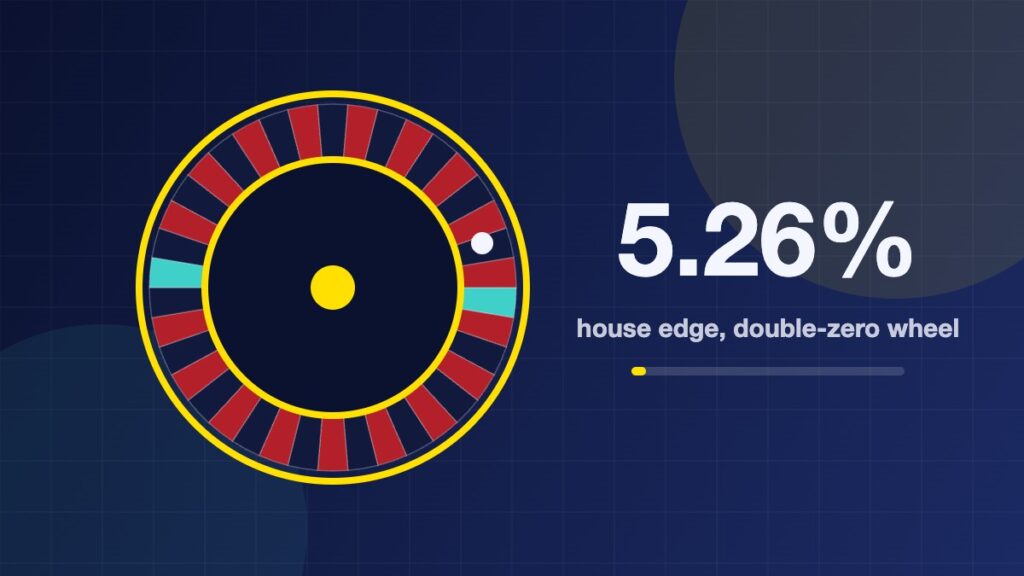
House edge is the share of every bet that a casino game is built to keep over the long run, written as a percentage of the amount wagered. It exists because winning bets pay slightly less than the true odds. On a double-zero roulette wheel the edge is 5.26%, so a $5 bet costs about 26 cents on average. That figure is an average over many bets, and a single session can finish well above or below it.
What is house edge?
The standard definition comes from the casino mathematics guide that Robert Hannum, a casino math professor, wrote for the Center for Gaming Research at the University of Nevada, Las Vegas. The guide starts from the player’s expected value, which is the average result of a bet made over and over. Seen from the casino’s side and written as a percentage of the bet, that number is the house edge. The guide also calls it house advantage and theoretical win percentage.
UNLV has taken the guide offline. The figures quoted here come from an archived copy last modified in June 2012. The roulette, craps and baccarat numbers follow from fixed rules, so their age does not affect them.
How is house edge calculated from the odds?
Multiply each outcome by its probability, add the results, and divide by the stake. Roulette is the cleanest example because every pocket is equally likely.
Maryland’s gaming regulator sets out the wheel in its standard rules. A single-zero wheel has 37 compartments and a double-zero wheel has 38. The numbers 1 to 36 alternate red and black, so 18 are red, and the zeros are green. A single number pays 35 to 1, red pays 1 to 1, and the first five numbers (0, 00, 1, 2, 3) pay 6 to 1.
| Bet | Wheel and payout | Math per $1 bet | House edge |
|---|---|---|---|
| Single number, single zero | 1 of 37 wins, pays 35 to 1 | 35/37 – 36/37 = -1/37 | 2.70% |
| Single number, double zero | 1 of 38 wins, pays 35 to 1 | 35/38 – 37/38 = -2/38 | 5.26% |
| Red, double zero | 18 of 38 win, pays 1 to 1 | 18/38 – 20/38 = -2/38 | 5.26% |
| First five, double zero | 5 of 38 win, pays 6 to 1 | 30/38 – 33/38 = -3/38 | 7.89% |
Both wheels pay 35 to 1 on a single number. The double-zero wheel has one more losing pocket, and that pocket nearly doubles the edge.
A game can also build its edge through the payout alone. A coin flip that pays $0.95 on a $1 win has an expected result of (0.95 x 0.5) – (1 x 0.5) = -0.025, an edge of 2.5%. Baccarat’s banker bet works this way: it pays 0.95 to 1 once the 5% commission is taken.
What is the house edge by game?
The UNLV guide states its figures for typical conditions and assumes optimal strategy. For blackjack it does not list the full rule set or the payout on a natural, and it puts the average player, mistakes included, at 2%.
| Game and bet | House edge | Conditions |
|---|---|---|
| Blackjack, single deck | 0.0% | Basic strategy, typical rules |
| Blackjack, six decks | 0.5% | Basic strategy, typical rules |
| Craps, pass line with double odds | 0.61% | Needs a pass line bet |
| Baccarat, banker | 1.06% | 5% commission, ties counted |
| Baccarat, player | 1.24% | Ties counted |
| Craps, pass line | 1.41% | No odds bet |
| Roulette, single zero | 2.70% | Standard bets |
| Roulette, double zero | 5.26% | All bets except first five |
| Slots | 5% to 10% | 2012 estimate, varies by machine |
| Baccarat, tie | About 14% | Pays 8 to 1, our calculation |
| Keno | 27% | Average |
The guide gives no figure for the tie bet. It does use banker probabilities of 45.86% to win and 44.62% to lose, which leaves 9.52% for a tie. A baccarat rules sheet on file with the Nevada Gaming Control Board pays the tie at 8 to 1. That gives (8 x 0.0952) – 0.9048 = -0.143, an edge of roughly 14%.
For slots, Nevada requires every gaming device to pay back at least 75% in theory, which caps the edge at 25%. Machines on casino floors keep far less. As of November 2026, UNLV’s latest report puts Nevada’s statewide slot hold at 7.13% for 2026, with monthly data through September. The Las Vegas Strip is at 7.84% and Reno at 5.68%.
House edge vs RTP: what is the difference?
They are the same number seen from opposite sides. RTP (return to player) is the share of wagers a game pays back over the long run, so RTP equals 100% minus the house edge. A game with a 97% RTP has a 3% edge. Nevada writes its slot minimum as a payout percentage, and our guide to what RTP means and how it is measured covers that side in detail.
How much will you lose? Stake x edge x number of bets
The guide gives casinos a formula for what a player is worth: average bet x hours played x decisions per hour x house advantage. From your side of the table that is the expected loss. The table below uses 100 bets of $10, which is $1,000 wagered.
| Game and bet | House edge | Expected loss |
|---|---|---|
| Blackjack, six decks, basic strategy | 0.5% | $5.00 |
| Baccarat, banker | 1.06% | $10.60 |
| Roulette, single zero | 2.70% | $27.00 |
| Any game with a 97% RTP | 3% | $30.00 |
| Roulette, double zero | 5.26% | $52.60 |
The number of bets does as much work as the edge. A $100 balance bet through ten times is $1,000 wagered. Network and withdrawal fees come on top, and our explainer on crypto transaction fees shows how they are set.
Why are house edge and volatility different?
Edge is the average result. Volatility is how far results spread around that average. The guide works two examples over 1,000 one-unit bets. On the craps pass line the average result is 14 units down, and 95% of the time the player finishes between 49 units ahead and 77 behind. On a single number at double-zero roulette the average is 53 units down, and the 95% range runs from 311 ahead to 417 behind.
A short session can end well ahead in either game. As the number of bets grows, the percentage lost closes in on the edge.
Why does no betting system change the house edge?
The expected loss of a series of bets is the sum of the expected losses of each bet. Every bet has a negative expectation, so changing the bet sizes changes how much you risk and leaves the percentage alone.
Take doubling after each loss, starting with $10 on red at a double-zero wheel. After seven straight losses you are down $1,270 and the next bet is $1,280, all to end up $10 ahead. Seven losses in a row have a probability of (20/38)^7, about 1.1%, or roughly once in 89 attempts. The system trades many small wins for a rare large loss, and 5.26% still applies to every dollar wagered.
How does house edge work in crypto games, and what does provably fair check?
Crypto dice and crash games are built around one fixed RTP, and every payout follows from it. In a crash game you cash out before a rising multiplier stops. If the game returns a flat 97% at every target, the chance of reaching 2x is 0.97 / 2, or 48.5%, and the chance of reaching 100x is 0.97%. The edge is 3% at both targets, and the 100x player loses about 99 rounds in 100. A low edge can still come with large swings.
Provably fair is a way to check a finished round. Before you bet, the game shows a hash of a secret server seed, typically made with SHA-256, a hash function standardized by NIST. The result is computed from that server seed, a seed you supply, and a counter that goes up with each bet. Once the game reveals the server seed, you can hash it yourself, compare it with the hash you were shown, and recompute the outcome. A match shows the result was fixed before you bet. The check says nothing about the payout rules, so the edge stays where the RTP puts it.
The coin you deposit does not change the edge either, a point our comparison of real money and crypto casino play goes through in more detail. Offshore crypto casinos hold no US state license, and whether you can legally play depends on your state. This is not legal advice, and our article on whether crypto gambling is legal in the US sets out the state picture.
Gambling should stay entertainment. If it stops being that, call the National Problem Gambling Helpline at 1-800-MY-RESET (1-800-697-3738).
Sources
- UNLV Center for Gaming Research, “Casino Mathematics” by Robert Hannum (archived page, captured January 3, 2022; last modified June 5, 2012)
- Maryland Lottery and Gaming Control Agency, “Standard Rules – Roulette,” Version 1.5
- Nevada Gaming Control Board, “Live Baccarat Rules of Play”
- Nevada Gaming Commission, “Regulation 14,” section 14.040, minimum standards for gaming devices
- UNLV Special Collections & Archives, “Nevada Slot Machines: Historical Hold Percentage Variations,” October 2026
- NIST, “FIPS 180-4, Secure Hash Standard (SHS)”
Bitcoin Casinos vs. Regular Casinos FAQ
In the UNLV guide, the bets under 1.5% are blackjack with basic strategy, the craps pass line, and baccarat’s banker and player bets.
No bet-sizing system can. The UNLV guide notes a few exceptions, such as card counting in blackjack and selected video poker machines played with perfect strategy.
No. It lets you confirm that a result was not changed after you bet. The game’s payout rules still set the edge.


Latest News