- >News
- >What Are Prediction Markets and How Do They Work?

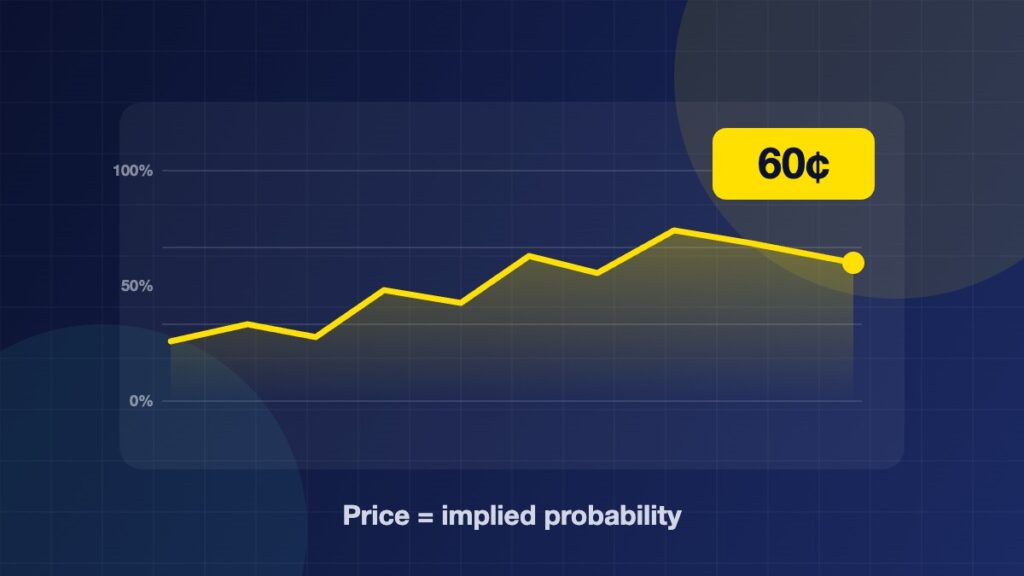
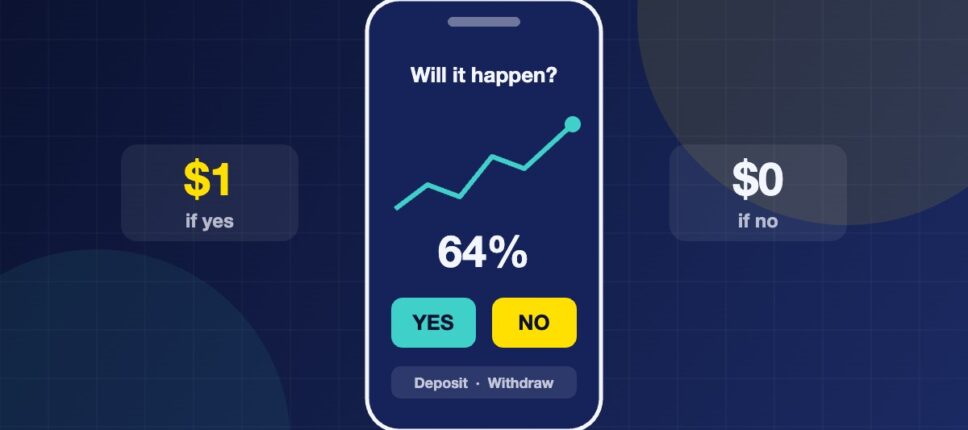
A prediction market is an exchange where people trade contracts on whether a future event will happen. Each contract pays $1 if the event happens and $0 if it does not, so a price of 60 cents means traders put the chance at about 60%. In the US, exchanges that offer these contracts to the public register with the Commodity Futures Trading Commission (CFTC). As of November 2026, federal appeals courts disagree on whether states can also apply their gambling laws to sports contracts, and a request to settle the question is pending at the Supreme Court.
What is an event contract?
An event contract is a derivative tied to one yes/no question with a set end date. The CFTC, in a June 2026 rule proposal, describes the markets for these contracts as what people commonly call prediction markets. The same document says total trading volume on CFTC-registered prediction markets passed $25 billion in 2025.
You buy “yes” if you think the event will happen and “no” if you think it will not. Polymarket US and Kalshi are two of the CFTC-registered exchanges, and our Polymarket vs Kalshi comparison covers how they differ. Polymarket US says you can trade a contract until the outcome is known.
How does a price between $0 and $1 read as a probability?
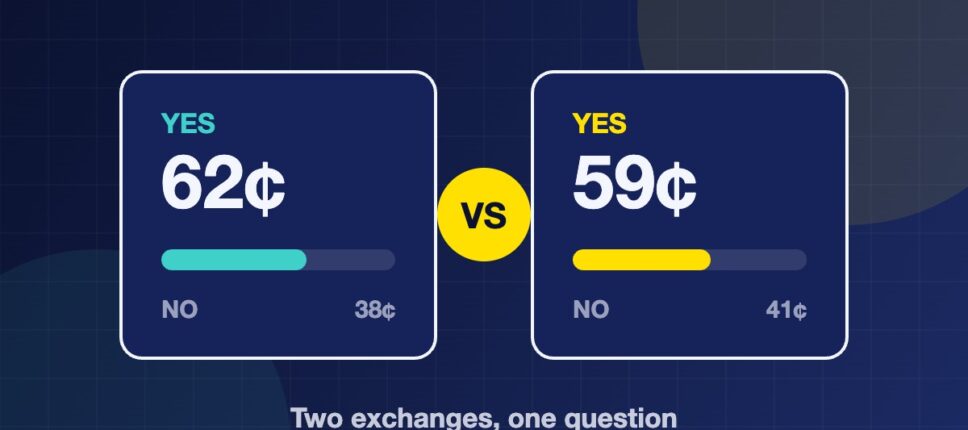
The contract pays $1 or nothing, so its price works as a probability in cents. A yes contract at $0.60 implies about a 60% chance. Buy it at $0.60 and you make $0.40 if you are right and lose $0.60 if you are wrong.
Prediction market vs sportsbook: how do the odds compare?
A sportsbook quotes odds and takes the other side of your bet. A prediction market matches you with another trader at a price. You can convert one format into the other:
- Implied probability = contract price in dollars
- Decimal odds = 1 ÷ price
- American odds for a price above $0.50 = -100 × price ÷ (1 – price)
- American odds for a price below $0.50 = +100 × (1 – price) ÷ price
| Contract price | Implied probability | Decimal odds | American odds |
|---|---|---|---|
| $0.25 | 25% | 4.00 | +300 |
| $0.50 | 50% | 2.00 | +100 |
| $0.60 | 60% | 1.67 | -150 |
An example with made-up numbers: you buy 100 yes contracts at $0.60 and pay $60. If the event happens you receive $100, a $40 profit. At a sportsbook, -150 means you risk $150 to win $100, so $60 also wins $40.
The two differ in where the cost sits. A sportsbook that prices both sides of a game at -110 is quoting 110 ÷ 210 = 52.4% for each side. The two add up to 104.8%, and the extra 4.8 points are the book’s margin. On an exchange one side pays $1 and the other pays $0, so your cost is the gap between buy and sell prices plus the trading fee.
Who sets the price?
Traders do. Polymarket US says its odds “come entirely from user trades” matched in a central order book, and that the exchange does not set prices or take the other side of your trades.
The other side can still be a professional. In its August 2026 opinion on Kalshi, the Ninth Circuit noted that an affiliate of the exchange, Kalshi Trading, trades on it largely as a market maker.
How do prediction market contracts resolve?
Each contract has written rules that name the source used to decide the outcome. Polymarket US lists government data, league results, named price indexes and named news outlets as its source types. When the result is public, the exchange confirms it against those rules. Winning contracts settle at $1.00 and losing ones at $0.00.
Sports markets often resolve shortly after the official result is posted, and political markets can take longer when certification is required. Resolutions are final under the exchange rulebook.
Are prediction markets legal in the US, and who regulates them?
This section reports what the sources say. It is not legal advice, and what you can trade differs by state.
At the federal level, the CFTC oversees designated contract markets (DCMs) under the Commodity Exchange Act. A DCM can list a new contract by filing a certification that it complies with the law. The Act singles out contracts that involve terrorism, assassination, war, gaming or activity that is unlawful under federal or state law, and the CFTC can decide whether such a contract is contrary to the public interest.
The CFTC has three rule actions in play as of November 2026:
- A proposal published June 12, 2026 would define “gaming” and set out a 90-day review process for these contracts. Its comment period closed July 27, 2026, and no final rule has been published.
- A proposal published October 19, 2026 would write event contracts, including sports ones, into the definition of “swap.” Comments close November 18, 2026.
- An interim final rule, effective October 19, 2026, states that casino-style gambling products, including sportsbook wagers and casino games, are excluded from the swap definition. It is also open for comment until November 18.
State gaming regulators object mainly to sports contracts, which they treat as sports betting without a state license. The exchanges answer that the contracts are swaps under the CFTC’s exclusive jurisdiction. Three federal appeals courts have ruled on Kalshi’s sports contracts, all at the preliminary injunction stage:
| Court | Date | State | Result |
|---|---|---|---|
| Third Circuit | April 6, 2026 | New Jersey | 2 to 1 for the exchange; contracts are swaps |
| Ninth Circuit | August 28, 2026 | Nevada | For the state; contracts likely not swaps |
| Sixth Circuit | September 25, 2026 | Ohio, Tennessee | For the states; no preemption of state law |
The Third Circuit left in place an order that stops New Jersey from enforcing its law against the contracts. The Ninth Circuit affirmed the removal of a similar order in Nevada and sent questions about election contracts back to the lower court. The Sixth Circuit held that federal law would not override Ohio’s or Tennessee’s gambling laws even if the contracts were swaps.
New Jersey has asked the Supreme Court to take the case (No. 26-299). Ohio, 38 other states and the District of Columbia filed a brief in support. Kalshi’s response is due December 7, 2026, and the Court has not said whether it will hear the case. The CFTC is on the other side of the states: on October 27, 2026 it announced a lawsuit against Utah and said it had started legal proceedings against nine other states.
What fees do prediction markets charge?
Fees are usually charged per trade and depend on the price. Kalshi’s schedule, last updated July 7, 2026, uses this formula for orders that match immediately: 0.07 × contracts × price × (1 – price), rounded up. For 100 contracts that is $0.07 at a price of 1 cent or 99 cents and $1.75 at 50 cents. The schedule lists no settlement fee and no fee on ACH transfers. These figures are as of November 2026.
In the earlier example, 100 contracts at $0.60 carry a $1.68 fee. Your cost becomes $61.68, so you break even only if the event happens more than 61.7% of the time.
What goes wrong most often?
- Skipping the rules. The contract resolves on the named source, even if you read the question differently.
- Treating the price as a fact. It is an estimate by the people trading, and a market with few orders can move a lot on one trade.
- Assuming access is permanent. A court ruling or state order can change what you can trade in your state.
- Trading on inside information. A February 25, 2026 CFTC enforcement advisory describes two traders whom Kalshi fined and suspended.
How is funding a prediction market account different from funding a crypto sportsbook?
Polymarket US asks for your legal name, address and Social Security number before you can deposit, and deposits must come from accounts in your own name. Its funding options include debit card, bank transfer and wire. Some exchanges also take crypto: Kalshi processes US crypto transfers through a third party, and Polymarket US lists USDC as a deposit option on iPhone where available.
A crypto sportsbook is a different setup. You send coins from your own wallet, and a network fee applies to each transfer, which our guide to how crypto transaction fees work explains. Offshore crypto sportsbooks and casinos hold no US state license, and whether using one is legal depends on your state. Our article on whether crypto gambling is legal in the US goes through the state rules.
Gambling should stay entertainment. If it stops being that, call the National Problem Gambling Helpline at 1-800-MY-RESET (1-800-697-3738).
Sources
- Supreme Court of the United States, “Docket for No. 26-299, Flaherty v. KalshiEX, LLC”
- US Court of Appeals for the Third Circuit, “KalshiEX LLC v. Flaherty, No. 25-1922”
- US Court of Appeals for the Ninth Circuit, “Opinion in No. 25-7516, filed August 28, 2026”
- US Court of Appeals for the Sixth Circuit, “Opinion No. 26a0272p, decided September 25, 2026”
- CFTC, “Further Definition of ‘Swap’-Inclusions,” Federal Register, October 19, 2026
- Kalshi, “Fee Schedule,” last updated July 7, 2026
Bitcoin Casinos vs. Regular Casinos FAQ
Courts disagree. The Third Circuit treated Kalshi’s sports contracts as federally regulated swaps, while the Ninth and Sixth Circuits let states apply their gambling laws to them.
Yes, if someone will buy it. You get the current market price, which may be higher or lower than what you paid.
Polymarket US says identity checks are required under federal anti-money-laundering rules before you can deposit or trade. Expect to give your legal name, address and Social Security number.


Latest News