- >News
- >RTP Meaning: What Return to Player Tells You and What It Doesn’t


RTP stands for return to player. It is the percentage of all money wagered on a game that the game is designed to pay back as prizes, averaged over a very large number of plays. A slot with a 96% RTP is built to return $96 of every $100 wagered across its whole life and keep $4. That average belongs to the game, and a single session can land far above or below it.
How is RTP calculated?
The UK Gambling Commission gives the formula in its guidance for online operators: divide the wins a game has paid by its turnover. Turnover is the total of all stakes, including winnings that players bet again.
The Commission’s worked example is a game designed with a 91.68% RTP that takes £1,200,000 in stakes in a month and pays £1,085,000 in wins:
1,085,000 / 1,200,000 = 0.9042, or 90.42%
That 90.42% is the actual RTP for the month. The 91.68% is the theoretical RTP, which the Commission defines as the designed return and the figure advertised in the game’s rules. After a significant amount of play, the Commission says, the actual figure should be very close or equal to the theoretical one.
RTP vs house edge vs volatility: what is the difference?
RTP and house edge describe the same money from opposite sides. Volatility describes how widely results swing on the way to the average.
| Term | What it measures | Example |
|---|---|---|
| RTP | Share of wagers paid back as prizes | 96% |
| House edge | Share of wagers the game keeps | 4%, or $4 per $100 wagered |
| Volatility | How far results swing around the average | High: rare, large prizes |
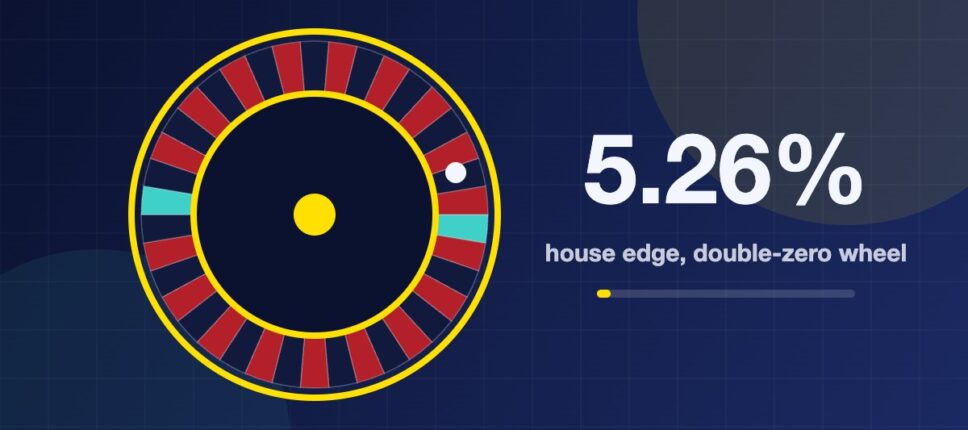
The Commission describes the house edge as the percentage a casino expects to keep, on average, from each hand or spin. For a game with a fixed RTP, that is 100% minus the RTP. Our guide to how the house edge works in each casino game covers table games, where the edge changes with the bet and the rules.
Operators usually express volatility as the game’s standard deviation. In the Commission’s wording, a highly volatile game pays prizes that are “very large but rare” and a low volatility game pays “small and often”.
Why doesn’t a 96% RTP mean I get $96 back from $100?
The first reason is that RTP applies to money wagered, and most players wager their deposit more than once. Take a hypothetical player who deposits $100 and plays 500 spins at $1, betting wins again along the way:
- Total wagered: 500 x $1 = $500
- Expected loss at a 4% house edge: $500 x 0.04 = $20
- Expected balance: $100 – $20 = $80
The deposit went through the game five times, so the 4% applied to $500.
The second reason is sample size. The Commission’s player guide says RTP is “an average achieved over a significant number of game plays” and that a machine showing 85% should not be expected to return 85 pence per £1 during a playing session. It adds that the average is generally measured over 10,000 or 100,000 games, and more for some machine types.
The operator guidance shows how slowly the number settles. For a game with a volatility (standard deviation) of 5.6, it lists the range a healthy game can fall in at a 95% confidence level:
| Games played | Allowed range around theoretical RTP |
|---|---|
| 50,000 | +/- 4.91 percentage points |
| 400,000 | +/- 1.74 percentage points |
| 1,000,000 | +/- 1.10 percentage points |
Even after 50,000 plays, that game could show an actual RTP almost five points away from its design and still be working correctly. The same guidance says measuring a game after only a small amount of play is pointless because the tolerance is too large to mean anything.
What rules set a minimum RTP?
Rules depend on where the game is licensed. The table shows what the published rules say as of November 2026. It is not legal advice.
| Body | Rule | Minimum theoretical RTP |
|---|---|---|
| Nevada Gaming Commission | Regulation 14.040 | 75% for each wager available |
| New Jersey | N.J.A.C. 13:69E-1.28A | 83% for slot machine games |
| UK Gambling Commission | Gaming machine guidance | None, but RTP must be shown |
| Gaming Laboratories International | GLI-19 v4.0 (November 3, 2026) | 75% for house-banked online games |
Nevada’s regulation adds that a gaming device must not alter any function based on its actual hold percentage. New Jersey calculates games with strategy choices, such as video poker, on optimal play. GLI-19 is a test lab standard for online gaming, and its 75% floor applies unless the regulator sets a different one. It also says a game shall not adapt its RTP to past payouts, except as the rules of the game provide.
Checking happens twice in Great Britain. Games are tested before release, and the designer’s theoretical RTP and volatility are reviewed as part of that external testing. After release, online operators must monitor each live game against its theoretical RTP and report a confirmed fault to the Commission.
Those rules bind licensed operators in those jurisdictions. Offshore crypto casinos hold no US state license, so no US state regulator checks their games, and legality depends on the state. Our explainer on whether crypto gambling is legal in the US goes through the state rules.
Can the same slot have different RTPs?
Yes. One studio’s page for one of its slots lists four RTP settings for the same title: 96.38%, 94.55%, 92.33% and 88.42%, as of November 2026. The page does not say who picks the setting used at a given site.
The gap between the top and bottom settings is large in house edge terms:
- 96.38% RTP: house edge 3.62%, or $36.20 per $1,000 wagered
- 88.42% RTP: house edge 11.58%, or $115.80 per $1,000 wagered
That is $79.60 more per $1,000 wagered, a house edge about 3.2 times as large, on a game that looks identical on screen.
What is a good RTP?
No regulator publishes a “good” number. The sources give reference points: legal floors of 75% in Nevada and 83% in New Jersey, and a top setting of 96.38% on the slot above. Each point of RTP is worth $1 per $100 wagered, so the useful comparison is between the versions of a game actually on offer.
Where can you find a game’s RTP?
Open the game’s help or info screen. The Commission’s guidance says the theoretical RTP is the figure displayed in the player-facing rules, so on a site licensed in Great Britain that screen is the reference. On an unlicensed site the help screen is the only figure available, and no regulator has checked it.
Some sites quote an actual RTP instead. GLI-19 says that figure should be shown with the number of game plays behind it and the period they cover.
How do provably fair games publish their edge?
Provably fair games let a player check each result. GLI-19 version 4.0 describes the method as a commit and reveal scheme. The platform publishes a cryptographic commitment to a secret server seed before that seed decides any outcome. The player supplies or can change a client seed. When one server seed covers many rounds, a nonce or counter makes each round’s inputs unique. Once the server seed is revealed, anyone can recompute the results.
The check confirms that the committed inputs and the outcome were not altered afterward. It says nothing about the payout rules, and the edge sits in those rules.
Take a hypothetical dice game that pays 2x on a bet with a 49.5% chance of winning:
- RTP: 0.495 x 2 = 0.99, or 99%
- House edge: 1%
A fair payout on a 49.5% chance would be 1 / 0.495 = 2.02x. The game pays 2x, and the difference is the edge.
What does RTP have to do with deposits and withdrawals?
Nothing directly. RTP describes the game, and the cashier decides how long a withdrawal takes and what it costs to move. Our crypto casino guide covers the cashier side, and the comparison of real money and crypto casinos shows how each type pays out. Network costs on a crypto withdrawal are covered in crypto transaction fees explained.
Gambling should stay entertainment. If it stops being that, call the National Problem Gambling Helpline at 1-800-MY-RESET (1-800-697-3738).
Sources
- UK Gambling Commission, “Return to player: how much gaming machines payout”
- UK Gambling Commission, “Live return to player performance monitoring of games of chance”
- Nevada Gaming Commission, “Regulation 14: Manufacture, Sale, Distribution and Approval of Gaming Devices and Games”
- New Jersey Division of Gaming Enforcement, “N.J.A.C. 13:69E, Gaming Equipment”
- Gaming Laboratories International, “GLI-19: Standards for Interactive Gaming Systems, Version 4.0”
Bitcoin Casinos vs. Regular Casinos FAQ
It is the percentage of all money wagered on the slot that it is designed to pay back as prizes over a very large number of spins. The rest is the house edge.
A higher RTP means a lower average cost per dollar wagered. It does not describe how results swing in a short session, which is what volatility measures.
On a regulated random game, no. The UK Gambling Commission says the odds on a random machine stay constant and are not affected by earlier wins or losses, and Nevada bars devices from changing function based on actual hold. An unlicensed site has no regulator enforcing either rule.


Latest News