- >News
- >Polymarket vs Kalshi: Regulation, Funding, Fees and Payouts Compared

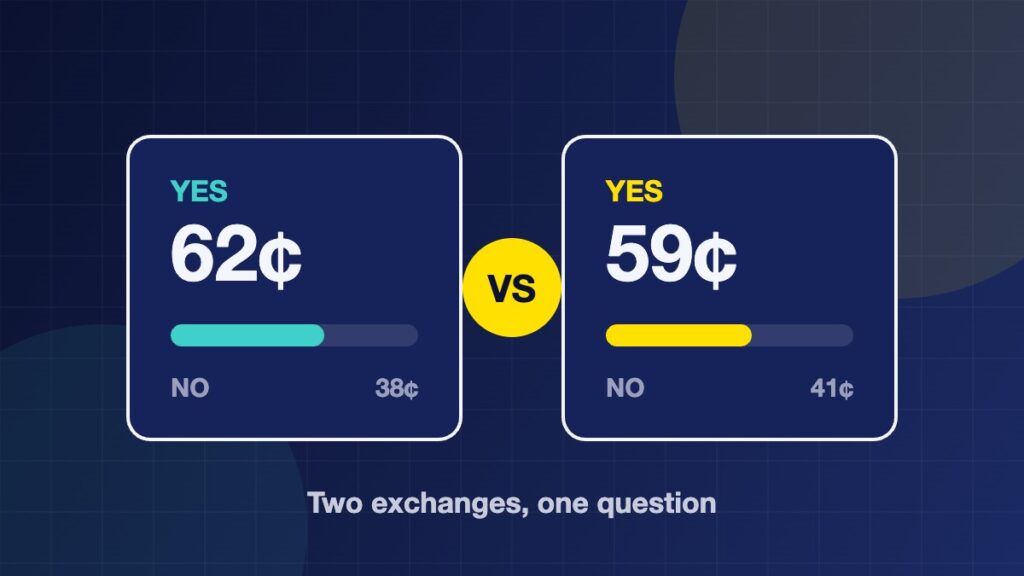
Kalshi and Polymarket US are both exchanges registered with the Commodity Futures Trading Commission (CFTC), and both hold US customers’ balances in dollars. The Polymarket most crypto users know, the one at polymarket.com that settles on Polygon, is a separate international product where people in the United States can only close existing positions. On published figures, Kalshi pays out faster and charges a lower trading fee to small accounts. The open legal question for both is sports contracts, which several states are fighting in court.
Polymarket vs Kalshi at a glance
Figures come from each company’s own pages, as of November 2026. On all three, a winning contract pays $1.
| Feature | Kalshi | Polymarket US | Polymarket international |
|---|---|---|---|
| CFTC status | Designated contract market | Designated contract market with its own clearinghouse | Separate crypto product |
| US residents | Yes, 18 and over | Yes, 18 and over | Close-only |
| Balance held in | US dollars | US dollars | pUSD on Polygon |
| Taker fee, 100 contracts at 50 cents | $1.75 on most markets | About $2.38 at the lowest tier | $0 to $1.75 by category |
| Who settles the market | Kalshi’s markets team | The exchange | UMA Optimistic Oracle |
| Card withdrawal time | A few hours | 3 to 4 business days | Not applicable |
If event contracts are new to you, our explainer on what prediction markets are covers how a contract is priced and paid.
Who regulates Polymarket and Kalshi?
The CFTC regulates both US exchanges. A CFTC order from July 2026 states that Kalshi obtained designation as a contract market on November 3, 2020.
Polymarket US is the trading name of QCX LLC. Its terms of service describe it as a CFTC-registered designated contract market and name QC Clearing LLC as its CFTC-registered clearing organization.
The international Polymarket is a different product. A CFTC notice published on October 19, 2026 refers to an earlier Commission order that penalized Blockratize, Inc., doing business as Polymarket.com, for offering event contracts without registering.
Is Polymarket legal in the US?
Yes, through Polymarket US, a federally registered exchange built for US residents. Signing up requires your legal name, residential address, date of birth, phone number and Social Security number. Our guide on how to use Polymarket US walks through the account and first trade.
The international site works differently for Americans. Polymarket’s developer documentation lists the United States among the close-only jurisdictions, meaning users can close existing positions and cannot open new ones.
Which states are fighting Kalshi and Polymarket?
The dispute is over sports contracts, and the federal appeals courts disagree with each other. The CFTC summarized the split in its October 19, 2026 notice.
| Court | Date | Holding, per the CFTC |
|---|---|---|
| Third Circuit | April 2026 | Sports contracts on a CFTC-licensed exchange are swaps |
| Ninth Circuit | August 2026 | These sports contracts are likely not swaps |
| Sixth Circuit | September 2026 | Sports contracts are not swaps |
The same notice says state trial courts have ordered one exchange to geofence sports contracts in Michigan, Washington and Nevada. It also describes a Minnesota law that makes operating a prediction market a felony, and a criminal case Arizona filed against an exchange. A CFTC order dated July 14, 2026 confirms that the Michigan case is against Kalshi.
Neither company’s help pages list the states or contract types it blocks, so check inside the app for what your location can trade. The CFTC’s proposal would define “swap” to explicitly include event contracts on sports, politics, culture and weather. Comments are due November 18, 2026, so nothing has changed yet. This is not legal advice, rules differ by state, and one court order can change the answer for yours.
How do you fund a Kalshi or Polymarket account?
Kalshi accepts debit cards, ACH bank transfers, PayPal, Venmo, Cash App, crypto and wire. The minimum deposit is $10, or $1,000 by wire. For US users, crypto deposits run through outside providers that include Stripe and Zero Hash, and typically take up to 30 minutes to reach the cash balance.
Polymarket US accepts debit cards, ACH, Apple Pay, PayPal, Venmo and wire, plus USDC on iPhone where available. Card and ACH deposits have a $50,000 daily limit and take 3 to 4 business days to process, although the app may credit instant buying power in the meantime. Wires start at $5,000 and take one business day.
Only the international Polymarket is crypto-native. All trading there uses pUSD, a token on Polygon backed by USDC.
What fees do Kalshi and Polymarket charge?
Both use the same formula: a coefficient, times the number of contracts, times the price, times one minus the price. The fee peaks at a price of 50 cents.
| Fee | Kalshi | Polymarket US |
|---|---|---|
| Taker coefficient | 0.07 on most markets | 0.095, falling to 0.0695 with volume |
| 100 contracts at 50 cents | $1.75 | About $2.38 at the lowest tier |
| Resting (maker) orders | Fee on some markets | No fee on standard trades |
| Card deposit | Up to 2% | Not published |
| ACH | Free both ways | Withdrawals free |
Kalshi’s schedule is dated July 7, 2026 and charges no settlement fee.
Polymarket US’s standard schedule took effect on October 28, 2026. An account with under $10,000 of taker volume in the past 30 days pays the 0.095 coefficient. The rate falls in steps to 0.0695 at $250,000 or more, where 100 contracts at 50 cents cost $1.74. The $2.38 figure is our arithmetic from the published coefficient (0.095 × 100 × 0.50 × 0.50 = $2.375, rounded to the cent). New accounts get the 0.0695 rate for their first seven days.
Polymarket US prices combos separately. Its combo taker formula changed on November 11, 2026, and combo maker fills carry a fee from November 14, 2026. The numbers above cover standard trades only.
How do markets resolve?
On both US exchanges the company decides. Kalshi says a market settles when the official outcome is confirmed and its markets team finalizes the result. Polymarket US says the exchange determines the result from the sources listed in the market’s rules, and that resolutions are final under its rulebook.
On the international Polymarket, an outcome is proposed through the UMA Optimistic Oracle with a bond, typically $750 in pUSD. A two-hour challenge period follows. A disputed market goes to a vote of UMA token holders and takes four to six days in total.
Which pays out faster?
Kalshi does, going by what each company publishes. Kalshi says most markets settle within a few hours after the outcome is known, often within about three. Polymarket US gives no figure and says sports markets often resolve shortly after the official result is posted.
On withdrawals, Kalshi says debit card payouts typically arrive within a few hours, bank transfers within a few business days and crypto within 30 minutes. Polymarket US lists 3 to 4 business days for both debit card and ACH. Neither charges a fee for card or bank withdrawals.
What tax paperwork do you get?
Kalshi says users who meet IRS reporting thresholds receive a 1099-INT for interest, a 1099-MISC for credits and rewards, a 1099-B for crypto transfers and a 1099-DA from Zero Hash. It also provides a yearly profit and loss statement calculated first in, first out, and says the statement is not tax advice.
Polymarket US’s terms say only that you are responsible for taxes on your activity.
Nothing here is tax advice, so confirm your own situation with a tax professional. If you also bet with coins elsewhere, our article on whether crypto gambling winnings are taxable covers that separate question.
What goes wrong most often
Uncleared deposits block withdrawals. On Polymarket US a deposit must fully clear, typically in 3 to 4 business days, before it or any proceeds tied to it can be withdrawn. Kalshi holds card and ACH deposits until they settle, and for up to two more days if you withdraw by a different method.
Money cannot always leave the way you want. Polymarket US returns withdrawals to the original funding source, in the order the deposits were made. Kalshi allows a crypto withdrawal only after a prior crypto deposit, and Cash App works for deposits only.
A court order can land while a position is open. After a Michigan restraining order, Kalshi filed an emergency rule to force-liquidate certain Michigan users’ open positions. The CFTC stayed that rule on July 14, 2026 and directed Kalshi to fulfill the trades.
How is the money path different from a sportsbook?
Polymarket US says your order is matched against another user’s order on a central order book, the platform does not take the other side, and you can sell before the event resolves. It also says customer funds sit in a dedicated account separate from its operating funds.
At a crypto sportsbook you send coins to the operator and bet against it. Offshore crypto betting sites hold no US state license, and whether using one is legal depends on your state, as we explain in is crypto gambling legal in the US. Our crypto betting page covers how deposits and cashouts work on those sites.
Gambling should stay entertainment. If it stops being that, call the National Problem Gambling Helpline at 1-800-MY-RESET (1-800-697-3738).
Sources
- Commodity Futures Trading Commission, “Further Definition of ‘Swap’-Inclusions” (proposed rule, Federal Register, October 19, 2026)
- Commodity Futures Trading Commission, “Order Staying Emergency Rule Filed by KalshiEX LLC” (July 14, 2026)
- Kalshi, “Fee Schedule” (effective July 7, 2026)
- Kalshi Help Center, “Transfers FAQ”
- Polymarket US Documentation, “Fees & Rebates”
- Polymarket US Documentation, “What is Polymarket US?”
Bitcoin Casinos vs. Regular Casinos FAQ
Only to close positions you already hold. Polymarket’s documentation lists the United States as close-only on both the website and the API.
For a small account, Kalshi, as of November 2026. Its standard coefficient is 0.07, and Polymarket US charges 0.095 until you pass $10,000 in 30-day taker volume.
No. Kalshi and Polymarket US both accept debit cards and bank transfers and keep your balance in dollars.


Latest News