





The most trusted cryptocurrencies for gambling include Bitcoin (BTC) for its security and wide acceptance, Ethereum (ETH) for faster transactions and smart contract support, Tether (USDT) for stability against price swings, and Litecoin (LTC) and Dogecoin (DOGE) for low-cost, quick transfers. This makes them popular choices at crypto casinos.
As online gambling continues to evolve, more players are turning to crypto wallets for more speed, privacy, and control over their funds. Find out what a crypto casino is and how a top-rated crypto wallet can help you to store your winnings securely.
1
Best Overall

Lucky Rebel
- Welcome Bonus
- 200% up to $2,500 + 50 free spins
Play Now
T&Cs apply • 18+

|
Affiliate Disclaimer
Please note that some links on CryptoVantage.com are affiliate links. We may receive a commission, at no extra cost to you, if you click through our links and make a purchase from one of our partners.
Best Crypto Gambling Wallets at a Glance
A gambling wallet gets used differently from a savings wallet. Small amounts, moving often, to deposit addresses you do not control, usually from whatever device you happen to be playing on. That changes which wallet is actually the right one.
On our general crypto wallet ranking the Ledger Nano S Plus finishes above the Nano X, because a USB-only device has a smaller attack surface than a Bluetooth one. Here that order flips. Most casino cashiers get used from a phone, and a wallet that cannot reach your phone cannot fund your account without a laptop in front of you.
These are the same five wallets we score on that page, re-weighted for this job. The table is ordered by Beacon Score.
| Wallet | Beacon Score | Role in a Two-Wallet Setup | Recovery Without the Vendor | Works From a Phone | Weakest Point for Gambling |
|---|---|---|---|---|---|
| ELLIPAL Titan 2.0 | 8.6 | Storage half | Yes — BIP39 phrase | Yes | Every transfer is a QR scan; slow for frequent play |
| Ledger Nano X | 8.5 | Storage half, fundable from a phone | Yes — 24-word phrase | Yes | Bluetooth widens the attack surface |
| Ledger Nano S Plus | 7.7 | Storage half | Yes — 24-word phrase | No | Needs a computer for every transaction |
| MetaMask | 7.1 | Play half | Yes — recovery phrase | Yes | EVM chains only — cannot hold Bitcoin |
| Zengo | 5.7 | Play half | No — Zengo must restore it | Yes | No independent recovery; access depends on the company |
Scores use the gambling weighting explained further down this page, so they differ from the same wallets’ scores on our general wallet ranking. “Storage half” and “play half” refer to the two-wallet setup described in the next section.
The Two-Wallet Setup That Decides What You Need
Using separate gambling and storage wallets limits how much crypto sits exposed in a wallet you open several times a week. The gambling wallet handles casino transactions; the storage wallet keeps what you are not actively playing with.
This is why the table above lists a role for each wallet. Nothing in the top three is meant to be the wallet you deposit from every evening, and neither of the bottom two is meant to hold a year of winnings.
| Wallet | Purpose | Holds | Type |
|---|---|---|---|
| Gambling wallet | Deposits and withdrawals | Active bankroll | Hot wallet |
| Storage wallet | Longer-term storage | Savings and withdrawn funds | Hardware wallet |
How Does the Two-Wallet Setup Work?
Set a gambling bankroll and transfer only that amount to your gambling wallet. For example, a $500 bankroll means moving $500 from storage to the hot wallet, then using that wallet for compatible casino deposits and withdrawals. When the gambling-wallet balance exceeds the amount you want available for play, you can transfer the surplus back to storage. Moving additional funds into the gambling wallet then requires a separate, deliberate transaction. This structure also limits the amount stored in an internet-connected hot wallet. Hardware wallets keep private keys offline when they are not being used to authorize transactions, making them better suited to storing funds that do not require frequent access. This is also the single change that does most for on-chain privacy. Sending straight from a KYC exchange to a casino creates an unbroken, permanently public link between your verified exchange identity and your gambling deposits; a dedicated gambling wallet in between breaks that direct link. Our guide to anonymous crypto casinos covers what that does and does not hide, and rates operators on how much personal information they collect regardless of which wallet you use.
The Five Wallets in Detail
Each rating below names the criterion that carries the wallet’s score and the one that drags it down, because an average hides the thing you actually need to know. All five are ordered by Beacon Score.
ELLIPAL Titan 2.0 — Beacon Score 8.6
The Titan 2.0 is the only wallet here with nothing a remote attacker can reach. No USB, no Bluetooth, no Wi-Fi. Every transaction leaves the device as a QR code that you scan with your phone, which means the private key has never touched an internet-connected machine and never will.
For a gambling bankroll that matters more than it sounds. The addresses you paste into a casino cashier come from a website, and address-swapping malware is one of the few attacks that reliably separates crypto players from their winnings. A device that signs offline and shows you the destination on its own screen is the strongest defence against that.
What carries the score: a perfect Attack Surface result and a standard BIP39 recovery phrase, so your funds are restorable in any compatible wallet without ELLIPAL’s permission or servers.
What holds it back: Usability, its lowest criterion. Every single transfer is a QR scan in both directions. For moving winnings into storage once a week that is fine. For topping up a bankroll three times on a Saturday night it is the slowest option on this page. At $169 it is also the most expensive.
Use it for: the storage half of the two-wallet setup, holding everything you are not actively playing with.
Ledger Nano X — Beacon Score 8.5
The Nano X is the compromise that makes sense for gambling specifically. It has the same certified secure element and the same 24-word recovery standard as the rest of the Ledger line, but it pairs with a phone over Bluetooth — which means you can fund a casino account from the sofa instead of fetching a laptop.
That is why it outranks the Nano S Plus here and sits below it on our general wallet ranking. The same Bluetooth radio that makes it practical is the thing that costs it points on Attack Surface. Which way that trade falls depends entirely on how often you intend to move money.
What carries the score: Platform Support — the only hardware wallet here that works properly from a phone, with full desktop coverage as well.
What holds it back: Bluetooth is a wireless radio on a device whose entire purpose is having no remote attack surface. Ledger’s implementation keeps the key inside the secure element and Bluetooth never carries it, but the pairing layer is still code that a device without Bluetooth simply does not run.
Use it for: the storage half, when you also want to deposit without a computer.
Ledger Nano S Plus — Beacon Score 7.7
The Nano S Plus is the same security proposition as the Nano X for less money: identical certified secure element, identical 24-word recovery standard, no Bluetooth. On our general ranking that absence is a virtue and it finishes above its more expensive sibling.
For gambling it is a real constraint. No Bluetooth means no phone pairing, which means every deposit and every withdrawal needs a computer, the Ledger app and a USB cable. If you play on a laptop anyway, nothing is lost and you have saved money. If you play on a phone, this wallet cannot fund your account.
What carries the score: Cost and Value — the cheapest route to the same security chip and the same recovery standard as anything else Ledger sells.
What holds it back: Platform Support, its lowest criterion here by a wide margin. On a page about funding casino accounts, a wallet that cannot reach a phone loses more than it does elsewhere.
Use it for: the storage half, for players who do their banking on a computer.
MetaMask — Beacon Score 7.1
MetaMask is the fastest wallet here to get money out of, and the one most likely to be useless at the casino you picked. It holds Ethereum and EVM-chain tokens. It does not hold Bitcoin, and it does not hold Litecoin — the two coins crypto casinos accept most consistently.
Check the cashier before you decide this is your play wallet. If the casino settles in ETH or in USDT on an EVM network, MetaMask is quick, free and already in your browser. If it wants BTC or LTC, MetaMask cannot be part of the plan at all.
What carries the score: a standard recovery phrase, so despite being a browser extension it is genuine self-custody — and Usability and Platform Support, where it is near the top.
What holds it back: Attack Surface, its lowest criterion by a distance. A browser extension is exposed continuously, and it is the single most impersonated wallet in crypto phishing.
Use it for: the play half, and only at casinos that settle on EVM chains.
Zengo — Beacon Score 5.7
Zengo is the easiest wallet on this page to use and the only one that cannot be recovered without the company that made it. There is no seed phrase. Recovery runs through Zengo’s own servers and a face scan, which is genuinely convenient and is also the reason it finishes last.
The question our scoring puts first is whether you could still reach your coins if the company disappeared tomorrow. For Zengo the answer is no. That is not a prediction about the company; it is a description of the dependency. A gambling bankroll is money you can afford to lose, which makes that dependency easier to accept here than it would be for savings — but it should be a decision, not a surprise.
What carries the score: Usability, where it beats everything else here, and solid mobile coverage.
What holds it back: Recovery Independence, worth 20% of the gambling score, where it is the only wallet to fail outright. Its MPC key model also leaves one key share with the vendor.
Use it for: the play half, if you accept that access depends on Zengo continuing to exist.
How CryptoVantage Scores Wallets for Gambling
The Beacon Score rates each wallet from 0 to 10 using the same nine criteria as our general wallet ranking, weighted differently. A wallet that holds a gambling bankroll is doing a different job from one holding savings, and the weighting follows the job.
1. Recovery Independence — 20%
Whether the wallet gives you a standard mnemonic phrase that restores your funds in any compatible wallet, without the manufacturer’s servers, apps or permission. Still the heaviest single criterion, but below the 25% it carries on the general ranking: a bankroll is money you have already decided you can afford to lose.
2. Attack Surface — 20%
What a remote attacker can reach. Raised from 15% because gambling means pasting addresses that came from a website, repeatedly. Address-swapping malware is the attack that actually takes players’ money, and the defence against it is a device that signs offline and shows you the destination on its own screen.
3. Platform Support — 15%
Desktop, mobile and browser coverage. Raised from 5%, and the single biggest reason the order here differs from the general ranking. Casino cashiers are used from phones. A wallet that needs a laptop for every transaction is a wallet you will stop using correctly.
4. Key Custody Model — 10%
Where the private key lives and who can reconstruct it. Keys inside a certified secure element score highest; split shares where one share sits with the vendor score lower; keys in software on an internet-connected device score lowest.
5. Transparency of Claims — 10%
Whether the manufacturer publishes verifiable specifications, and whether its own numbers agree with each other.
6. Usability — 10%
Raised from 5%. Setup matters once; a gambling wallet is used several times a week, and friction that is tolerable annually becomes a reason to cut corners.
7. Asset and Network Coverage — 5%
Lowered from 10%. Crypto casinos accept a handful of coins, not thousands, so a catalogue of fifteen thousand tokens is close to irrelevant here. What does count is whether the wallet holds the specific coins and networks casinos settle in — which is why MetaMask is marked down despite broad token support.
8. Cost and Value — 5%
Lowered from 10%. Price against what you get.
9. Track Record and Support — 5%
Operating history, documented security incidents and how the vendor handled them.
Why These Scores Differ From Our General Wallet Ranking
Two wallets change places. The Ledger Nano X rises from 7.8 to 8.5 and passes the Nano S Plus, because Platform Support triples in weight and the Nano X is the only hardware wallet here that reaches a phone. The ELLIPAL Titan 2.0 slips from 8.7 to 8.6, holding first place but losing ground on Usability, since scanning a QR code for every transfer costs more on a page about frequent deposits than it does on a page about storage.
The Beacon Score is an editorial rating. Affiliate relationships do not affect it, and a manufacturer cannot pay to raise it.
Hot Wallet or Hardware Wallet for Gambling?
A gambling wallet is not optional in the way it is for buying and holding. Casinos pay out to an address you control, and if that address belongs to an exchange account rather than a wallet you hold the keys to, you are trusting a third party with money you just won. A trusted and safe crypto wallet is essential for anyone looking to gamble online with digital coins. Cryptographic tech allows you to store, send, or receive crypto, without going through an exchange. Like a physical wallet, this virtual wallet acts as your personal banking system, giving you full control over your funds, eliminating intermediaries, and keeping your gambling activities discreet. As a plus, connecting your self-custodial wallet to a crypto casino, means that you do not have to share sensitive information, like your credit card or banking details. Instead, you use your wallet to transfer assets directly. This enhances privacy and adds a layer of protection against fraud, identity theft, and chargebacks. In many ways, this ensures that your casino transactions stay truly anonymous and fully in your control. Importantly, most reputable crypto casinos won’t store your crypto balance indefinitely. This means that it is best to withdraw your winnings regularly – which is just another thing that a reputable wallet is great for. Whether it’s Bitcoin, Ethereum, or a stablecoin like USDT, your wallet acts as the bridge between your real-world value and your online bets.
Which Type of Crypto Wallet Is Best for Gambling?
A self-custody hot wallet is generally more practical for frequent casino deposits and withdrawals, while a hardware wallet is better suited to storing funds that do not require frequent access. The two wallet types therefore serve different roles rather than competing directly. For an active gambling wallet, prioritize asset and network compatibility, control of private keys, transaction fees, address management, and ease of sending and receiving funds. For storage, prioritize private-key security, recovery options, device compatibility, and supported assets. Hot wallets are better for frequent gambling deposits and withdrawals, while hardware wallets are better for storing crypto you do not need for regular transactions. Using both can separate your active bankroll from longer-term holdings.
Why Use a Hot Wallet for Gambling?
Hot wallets provide faster access to funds for regular casino transactions. Wallets such as RockWallet, Exodus, Trust Wallet, and Electrum run on internet-connected devices, making them convenient for deposits and withdrawals but more exposed to phishing, malware, and device compromise.
Why Use a Hardware Wallet?
Hardware wallets are better suited to storing winnings and funds between gambling sessions. Ledger, Trezor, and ELLIPAL devices isolate private keys and require additional transaction authorization, trading some convenience for stronger key protection. A hot wallet alone can be sufficient for an active bankroll. A two-wallet setup becomes useful when you want to separate gambling funds from longer-term crypto holdings.
Which Coins and Networks a Gambling Wallet Must Hold
Matching the Coin to the Casino — and to the Network
Bitcoin, Litecoin, and stablecoins are practical options for a gambling wallet, but the best choice depends on casino support, network fees, transaction speed, and price volatility. Always confirm both the cryptocurrency and blockchain network before transferring funds.
- Litecoin (LTC) — Litecoin can provide lower transaction fees and faster block confirmation than Bitcoin under many network conditions. It is supported by many gambling sites that accept cryptocurrency.
- Bitcoin (BTC) — Bitcoin has broad support among crypto gambling sites and wallets. Network fees and confirmation times vary with demand, making current network conditions relevant before sending a transaction.
- USDT and USDC — Stablecoins are designed to track a reference asset such as the US dollar, reducing the price volatility associated with BTC or LTC. Network compatibility matters: the casino and wallet must support the same blockchain for the selected stablecoin.
- Ethereum (ETH) — Ethereum has broad wallet support, but transaction fees can vary significantly with network activity. Check the current fee before using ETH for frequent transfers.
- Other cryptocurrencies — Bitcoin Cash, Dogecoin, Solana, XRP, and other assets may also be available. Support depends on both the gambling site and wallet, including the required network.
The coin matters less than the network it arrives on. USDT exists on Ethereum, Tron and several other chains, and a casino that credits TRC-20 deposits will not credit the same tokens sent over ERC-20. Confirm both before you send anything.
Litecoin and Bitcoin are the most consistently accepted pair across the casinos we review, which is the practical reason an EVM-only wallet like MetaMask is a limited choice here. Our Litecoin casino ranking covers which operators handle LTC on both sides of the cashier, and the Bitcoin and Ethereum guides do the same for those networks.
How to Fund a Casino Account From Your Wallet
Now that you have all the context for what crypto casinos are and how they operate, it’s time to dive into how to set up your wallet and connect it to your favorite gambling site. The process will likely differ slightly from one site to the next, but generally, all you have to do is:
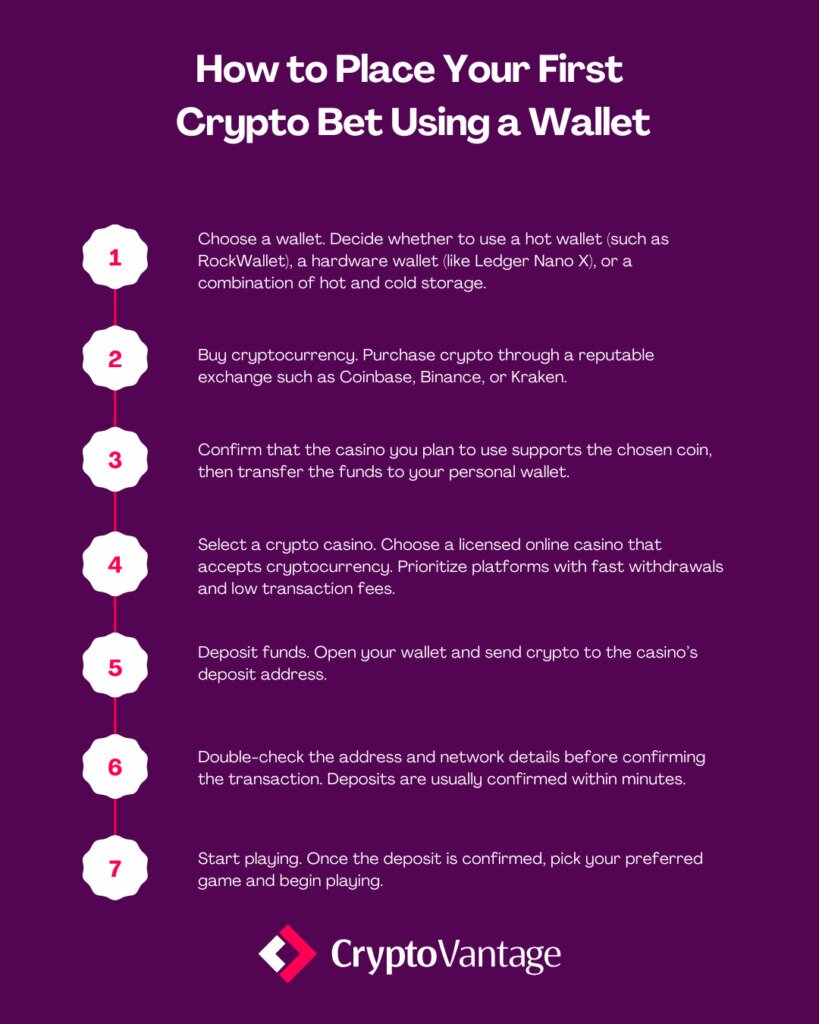
From there, all you have to do is to stay on top of your bankroll management. When you have built up a fair amount of winnings, be sure to withdraw the funds back to your personal wallet for safekeeping.
💡 CryptoVantage tip: Move large balances to a cold wallet. Back up your recovery phrase and keep it offline.
Mistakes That Cost Crypto Players Money
Keep these expert-verified tips in mind to get the most out of your crypto casino experience.
It’s advisable to gamble on reputable, well-known platforms. While crypto gambling always carries risk, selecting a licensed and trustworthy site helps protect your funds and personal information.
You should always look out for casinos that offer provably fair gameplay. Legitimate platforms use random number generators, work with independent auditors, and clearly display their payout guarantees.
Taking advantage of crypto casino bonuses is a must, as these promotions can boost your bankroll and give you more flexibility to test and refine your strategies.
Most importantly, gamble responsibly. Never bet more than you can afford to lose.
The Bottom Line: Which Wallet Should You Actually Use?
If you want one wallet and you play from a phone, the Ledger Nano X is the answer at 8.5: hardware-grade key storage, a standard recovery phrase, and the only one in that class you can actually deposit from without a computer.
If you are willing to run two, the stronger setup is the ELLIPAL Titan 2.0 at 8.6 holding everything you are not playing with, paired with whichever hot wallet your casino’s cashier supports — MetaMask on EVM chains, Zengo elsewhere. Keep the bankroll small enough that losing the hot wallet would be annoying rather than serious.
Skip Zengo as a storage wallet. It scores 5.7 here for one reason: there is no seed phrase, and recovery runs through the company. That is a reasonable trade for a playing balance and a bad one for winnings you intend to keep.
Whatever you choose, gambling carries financial risk and no wallet changes that. Only play with money you can afford to lose. Our crypto casino ranking covers the operators themselves, scored on the same Beacon Score system.
FAQs
Cold wallets, such as hardware devices like the Ledger Nano X or Trezor Model T, are the safest for storing your crypto funds long-term. They keep your private keys offline, reducing the risk of hacks or malware attacks. However, for frequent gambling transactions, a reliable hot wallet like RockWallet can offer better convenience with solid security if proper precautions (like 2FA) are used.
Not all wallets are ideal. You need a non-custodial wallet (where you control your keys) that supports the crypto accepted by the casino. Wallets like RockWallet, Ellipal, Ledger, and Trezor are all compatible with most crypto casinos. Avoid using centralized exchange wallets (like Binance or Coinbase) for deposits, as they may delay or block gambling-related transactions.
Crypto offers pseudonymous transactions—your identity isn’t directly tied to your wallet address. However, casinos may still require ID verification for withdrawals depending on their licensing. Using a non-custodial wallet enhances privacy, but full anonymity depends on the platform’s KYC policies and the blockchain used (e.g., Monero is more private than Bitcoin).
Yes. Transacting with crypto offers unparalleled privacy and security. To add to this, the sites that we have chosen double up on their on-site security protocols with encryption, two-factor authentication, and various other technologies.

Latest News