- >Best Crypto Exchanges
- >dYdX Review
dYdX Review 2026: Features, Fees, Security & User Testing Insights
Affiliate Disclaimer: Some links on this page are affiliate links. CryptoVantage may earn a commission at no extra cost to you if you click through and sign up. This does not influence our evaluation methodology or conclusions.
Last Updated: March 2026 (review refreshed with updated testing and structural improvements).

Please note that some links on CryptoVantage.com are affiliate links. We may receive a commission, at no extra cost to you, if you click through our links and make a purchase from one of our partners.
How This Assessment Was Conducted
This review was conducted following CryptoVantage’s established exchange testing methodology. Our evaluation includes account registration, wallet connection and verification, deposit and withdrawal testing where feasible, fee structure analysis, trading interface usability, security feature assessment, and customer support responsiveness. We assess exchanges based on transparency, operational clarity, cost structure, custody model, risk controls, and suitability for different types of users. Reviews are updated when material platform changes occur or when new regulatory, architectural, or operational information becomes available.
About the Reviewer
Scott McDonald is a cryptocurrency analyst and financial technology writer specializing in digital asset regulation, exchange compliance, and blockchain market structure. He focuses on delivering clear, research-driven insights that help investors understand how policy, security standards, and platform safeguards shape the crypto ecosystem.
Prior to covering crypto, Scott worked extensively in the iGaming industry, analyzing online gaming platforms, licensing frameworks, and digital payment systems across multiple jurisdictions. His background in compliance and consumer protection informs his practical, risk-aware approach to cryptocurrency reporting at CryptoVantage.
Scott McDonald’s Testing Experience at dYdX
“I connected to dYdX in February 2026 by linking a self-custody wallet and evaluating key aspects of perpetual futures trading in practice. As a decentralized exchange, dYdX did not require traditional onboarding or KYC, instead relying on wallet authentication — which worked smoothly but places full responsibility on the user to protect private keys.
During testing, I examined fee visibility, order placement mechanics, perpetual contract leverage options, and wallet-backed transactions. The web interface was responsive on desktop, though traders unfamiliar with derivatives may face a steep learning curve given concepts like funding rates, automatic liquidations, and cross-margin risk parameters.
Customer support was accessible via the online ticketing system, though response times varied based on complexity of the query. While the platform’s decentralized nature enhances asset sovereignty, it limits fiat support and spot trading — which may not suit users seeking a complete trading suite.”
dYdX Quick Facts
Company Overview
- Type: Decentralized Exchange (DEX)
- Core Product: Perpetual futures trading
- Custody: Non-custodial (users maintain wallet control)
- Spot Trading: Not currently available

A decentralized exchange specializing in perpetual futures trading.
Pros
True decentralization with self-custody
Zero gas fees for trading
Competitive fee structure for derivatives
Advanced order types and leverage support
Strong security track record and audits
Cons
No native spot trading
Limited fiat on-ramp options
Steep learning curve for beginners
Access restricted in certain jurisdictions (U.S., UK, Canada)
Supported cryptocurrencies
250+ assets supported
Fiat Currencies Accepted
None directly (USDC used as collateral)
Trading Volume and Liquidity
$270 billion in 2024, $1.46 trillion cumulative
Market Reach
53,000+ DYDX token holders, over 2 million transactions processed
Customer Support
Online ticketing and live chat
Who dYdX May Suit — And Who It May Not
May Suit Users Who:
- Want a decentralized, self-custody derivatives platform
- Are experienced with perpetual contracts and leverage
- Prefer advanced order types and protocols over custodial services
Not Ideal For Users Who:
- Seek beginner-friendly, fiat-on-ramp spot trading
- Prefer regulated, centralized exchange protections
- Cannot manage their own wallet security and keys
This content is for informational purposes only and does not constitute investment advice.
Fees and Costs
Trading Fees
dYdX uses a maker/taker fee model based on trading volume over the previous 30 days. Perpetual trading fees — the exchange’s core product — typically sit competitively below industry averages, rewarding higher-volume traders with lower rates. (CryptoVantage)
Deposit & Withdrawal Fees
As a non-custodial protocol, there are no deposit or withdrawal fees charged by dYdX; users only pay standard blockchain network fees when moving assets. (CryptoVantage)
Hidden Costs
Network congestion can increase underlying blockchain fees, and some third-party fiat-on-ramp services (when used) may impose their own costs. (CryptoVantage)
Security and Custody
Custody Model
dYdX operates non-custodially — users retain control of assets via wallet connections (e.g., MetaMask, Ledger). This minimizes centralized counterparty risk but places responsibility on users to secure private keys.
Protocol Security
The dYdX Chain has undergone comprehensive audits with no critical issues noted, and its bug bounty program incentivizes ongoing vulnerability reporting.
Incidents & Mitigation
The platform historically has not suffered major hacks affecting user funds, though a chain outage in late 2025 briefly impacted service continuity.
Regulatory Notes
dYdX does not hold formal licenses in major jurisdictions and uses geo-blocking to manage compliance risks.
Products and Features
Trading Interface
dYdX delivers an advanced derivatives trading suite with conditional and algorithmic-style orders, cross-margin risk mechanics, and leverage up to 50x on major pairs.
Supported Assets
Perpetual markets cover a range of major cryptocurrencies, though availability is narrower than many centralized exchanges.
Mobile & API Tools
Web and mobile interfaces support simplified and professional trading modes. Official API offerings enable automated strategies and programmatic access.
Customer Support
Support is available through in-app help chat and online ticketing, with documentation and FAQs providing additional context. Response times vary based on query complexity.
Known Issues & Reputation
While dYdX generally holds a strong reputation in DeFi circles, some users cite complex interfaces, perceived liquidity nuances in specific markets, and occasional uptime issues. These user-generated observations are mixed and not verified by official sources. (Reddit community discussions reflect a range of experiences — both positive and negative — around usability and liquidity, but should be interpreted cautiously.) (Reddit)
Supported Assets & Markets
Popular cryptocurrencies, like Bitcoin and Ethereum, are available for trading, along with a wide range of altcoins.





Cryptocurrencies & tokens
As for crypto, the exchange covers all major cryptocurrencies, including Bitcoin, Ethereum, Solana, and a wide range of altcoins. There are perpetual trading options for over 35 popular cryptocurrencies, including Bitcoin (BTC), Ether (ETH), Dogecoin (DOGE) and Cardano (ADA).
Fiat pairs
The exchange doesn’t support traditional fiat currency deposits or trading pairs directly. All perpetual contracts are quoted in USD but settled in USDC stablecoin, which is the platform’s universal collateral asset.
They have also integrated fiat onramp services to make funding easier. The mobile app supports direct fiat deposits through MoonPay.
Derivatives market availability
Perpetual contracts are the exchange’s specialty, a type of derivative that lets traders speculate on the price of an asset without actually owning it, and unlike traditional futures, does not have an expiration date. Each market offers different leverage limits, with most major pairs supporting up to 20x-50x leverage depending on the asset and market conditions.
Geographic availability
Geographic availability is in 180+ global countries, including regions often restricted on other platforms such as China, Russia, South Korea, Japan, and Vietnam. The platform currently blocks access in the USA, Canada, the UK, Iran, Cuba, North Korea, Syria, Myanmar, Crimea, Donetsk, and Luhansk to comply with AML, CTF protocols, and sanctions enforcement.
Geographic restrictions are implemented through the centralized frontend managed by the dYdX Foundation. VPNs can technically bypass blocks, but the exchange prohibits VPN usage in its terms and has suspended accounts for violations. They plan to enter the US market by the end of 2025.
Usability & User Experience
The platform provides a flexible web and mobile interface with simplified and advanced modes, making trading accessible while still supporting professional workflows.
Desktop & web interface
The web platform features a modular, responsive interface optimized for quick execution. The layout groups information based on similarity and importance, with customizable sections that can be minimized to create more room for market data and charts. The interface works across ultra-wide monitors, laptops, and tablets while balancing power user requirements with accessibility for first-time traders.
Mobile app experience
The latest app update brings a faster, more intuitive trading experience with a simplified interface designed to onboard the next generation of perpetual traders. The mobile app experience has been streamlined to reduce friction while maintaining access to essential trading functions.
Two-mode operation lets beginners stick with simplified controls while advanced traders can access the full feature set. The app handles wallet connections smoothly and processes deposits/withdrawals with significantly improved speed compared to earlier versions.
Learning curve
There is a steep learning curve for beginners new to derivatives. You must understand concepts like leverage, liquidation prices, funding rates, margin requirements, and automatic liquidations.
The Default Mode in the mobile app and configurable web interface helps reduce initial complexity by presenting information progressively. Advanced traders familiar with derivatives will find the interface intuitive and comparable to professional platforms.
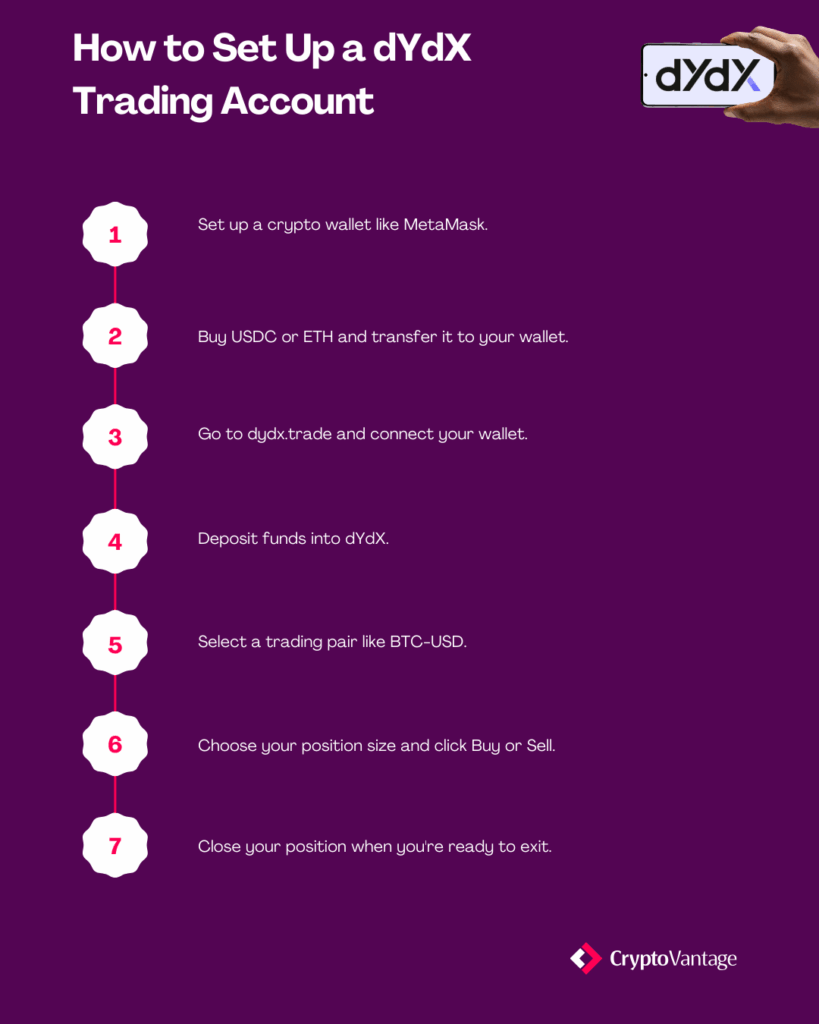
How to Get Started with dYdx
Here’s a quick guide for setting up a crypto exchange account on the platform.
Bottom Line
dYdX stands out as a decentralized derivatives platform prioritizing self-custody, protocol security, and advanced features. It excels for experienced perpetual traders but may not suit those seeking extensive fiat options, beginner-friendly tools, or regulated protections.
Disclosures & Sources
Affiliate Disclosure
CryptoVantage may earn a commission if users sign up through links in this review. This does not influence our methodology or findings.
Sources
Articles and platform details accessed March 2026.
dYdX Alternatives
dYdX is a great option if you want a derivatives platform, but it may not suit everyone’s trading needs or preferences. Other centralized and decentralized exchanges offer different feature sets that might better match your requirements.
If you’re weighing your options, consider some of the best cryptocurrency exchanges, like Binance for high-volume traders wanting both spot and derivatives with deep global liquidity, Bybit for derivatives traders who want competitive fees and advanced charting tools, or Kraken for U.S. traders needing regulated access with strong security.
Exchange
Ideal For
Fees & Pricing
Security Features
Regulation & Compliance
dYdX
Decentralized derivatives traders
Maker/taker: 0.02%/0.05
Self-custody security
Not available in U.S.
High-volume multimarket traders
Maker/taker: 0.10%/0.10%
SAFU fund protection
Globally licensed
Regulatory-conscious traders
Maker/taker: 0.16%/0.26%
Proof-of-reserves
U.S. regulated
Final Thoughts & Verdict
dYdX is great for experienced derivatives traders who value self-custody and want perpetual futures without trusting centralized platforms with their funds. They suit algorithmic traders and market makers needing API access with low latency. It’s not ideal for beginners, casual traders wanting spot markets, or anyone uncomfortable with derivatives’ complexity.
The exchange successfully delivers decentralized derivatives trading at scale, processing massive volumes while maintaining self-custody and competitive fees. Technical improvements in 2025—faster deposits, mobile enhancements, and instant market listings—address previous limitations. Weaknesses include specialization: no spot trading, the learning curve discourages beginners, and geographic restrictions limit market reach.
Overall, this provider delivers professional derivatives trading with decentralized infrastructure remarkably well. It’s a solid option for perpetual futures trading. If derivatives trading aligns with your strategy and you’re comfortable with DeFi infrastructure, they deserve serious consideration. For everyone else, platforms offering spot trading provide better starting points.
FAQs
Overall, this provider delivers professional derivatives trading with decentralized infrastructure remarkably well. It’s a solid option for perpetual futures trading. If derivatives trading aligns with your strategy and you’re comfortable with DeFi infrastructure, they deserve serious consideration. For everyone else, platforms offering spot trading provide better starting points.
This decentralized exchange specializes in perpetual futures contracts with up to 20-50x leverage across 235 trading pairs. It eliminates intermediaries, letting you trade directly on the blockchain and maintain self-custody of your funds.
They are safer than centralized exchanges because you control your own funds. The platform never holds your assets.
No, they don’t require KYC or identity verification. You simply connect a Web3 wallet like MetaMask to start trading immediately. This provides privacy but also means you’re fully responsible for your account security.
They suit experienced derivatives traders comfortable with leverage, funding rates, and liquidation risks. It’s ideal for algorithmic traders and market makers needing API access.
Liquidity on dYdX is provided by the users, much like on Uniswap, PancakeSwap, or SushiSwap. Users deposit liquidity in exchange for rewards in the form of fees, and this is where the liquidity comes from. dYdX provides none of their own liquidity, as it is decentralized.
A Stark Key is a public key that links a user’s Ethereum key with dYdX’s smart contracts. This Stark Key is used to identify a user’s account on dYdX’s Layer-2 infrastructure and is saved locally on the user’s browser.